


XVII Summer School of Economics officially opened
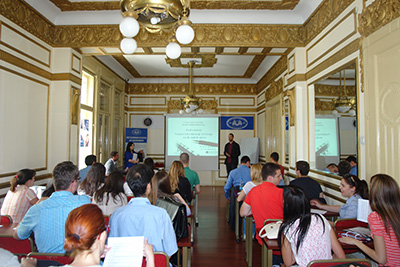
On Monday 14th July, 2014, XVII Summer School of Economics was officially opened by Prof. Dejan Erić, director of the Institute of Economic Sciences. In his opening speech, prof. Erić welcomed the participants and expressed his satisfaction with the fact that the school maintained continuity in a very difficult economic situation.
In the opening ceremony, introduction speeches were held by Mr Henry Bohnet, Head of the Konrad Adenauer Stiftung offices in Serbia and Montenegro, main school donator and Mr Ramunas Janusauskas, Head of Information, Communication and Press of the EU Delegation in Serbia.
The first lecture was given by Director of the Institute of Economic Sciences, Prof. Dejan Eric. He gave an interesting presentation on the recent trends in the corporate restructuring in the SEE region. Participants had an opportunity to discuss with Prof. Eric about importance of corporate restructuring, main problems which companies in the region face and alternative views on restructuring of state owned companies.
Afternoon lecture today was given by Mr Zoran Birovljevic and Ms Dusica Birovljevic from the Nomotechnical Center, Belgrade. They held presentation titled Be Original. Scienti¬fic Paper in Function at Creating New Jobs stressing the risks of plagiarism and importance of developing proper institutional framework to prevent plagiarism in scientific publishing.
The second day of the XVII Summer School of Economics
Second day of the XVI Summer School was opened by Mr. William Bartlett, Senior Research Fellow in the Political Economy of Southeast Europe, LSEE. Prof. Bartlett covered the topic of economic development perspectives in the Western Balkan region with a special reference to the structural reforms that are required to stimulate economic growth and export. During the first lecture, he stressed that WB countries need to continue their EU integration process which is of crucial importance for the economic stability. However, he stressed that significant export enhancement in the region may be also improved by recovering old economic relations with a countries which were members of form e non-aligned countries. During the second lecture, prof. Bartlett discussed with participants the main structural reforms that are necessary to boost competitiveness. As one of the most important measure which could provide long term improvement of competitiveness, he stated investments in education and reform of education policy.
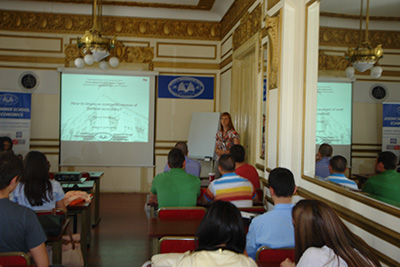
During the afternoon, it was held a workshop titled How to Improve Competitiveness of Serbian Economy? given by IES researchers Ms Slavica Stevanovic and Ms Sonja Djuricin. They discussed on importance of competitiveness concept in a modern world, measures of competitiveness and main obstacles that WB countries need to overcome in order to build more competitive economies. During the workshop, IES researchers gave a more detailed critique of the relevant competitiveness measures and performed brief inquiry focused on participants’ attitude concerning main factors of competitiveness in the region.
Third day of the XVII Summer School of Economics
The first two lectures of the third day were held by Mr. Sasa Radulovic, former Minister of the Economy of the Government of the Republic of Serbia. During the first lecture titled „Budget and GDP Structure of the Republic of Serbia“, Mr Radulovic explained why Serbian economy failed to achieve desired level of economic development stressing that main problem of the Serbian economy is unrealistic economic policy which is currently led by the policy makers. According to him, Serbia needs complete change of economic paradigm. Some of the measures which could be useful in that process are reform of tax system, decrease of informal economy and creation of attractive environment for small and medium enterprises.
During the second lecture, Mr Radulovic stressed that privatisation process based on inadequate legislative influenced high corruption during the whole transition period while political elites did not do anything to stop those tendencies.
In the afternoon session, IES researchers, Mr Dusko Bodroza and Mr Sasa Milivojevic, held workshop titled How to Resolve Main Economic Issues in the WB Region? They presented foreign direct investments trend in the last couple of years. During the discussion with the participants, Bodroza and Milivojevic tried to find answer why WB countries failed to achieve more investments and what are the main barriers in the process of their attraction. Moreover, they highlighted main problems in the functioning of the pension system in Serbia, its unsustainability and potential reform measures.
The forth day of the XVII Summer School of Economics
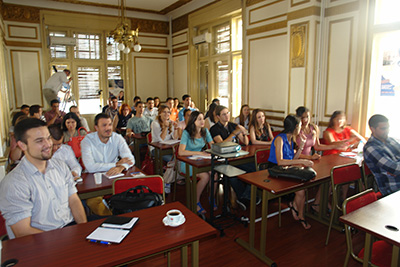
Mr. Marko Malovic, Associate professor and researcher at the Institute of Economic Sciences held opening lecture on the fourth day of the XVII Summer School of Economics. He gave lesson on Trends in the Evolution of the International Monetary System. In a very interactive atmosphere of vivid discussion participants had opportunity to echange their opinion with Prof. Malovic regarding the current trends in the field of international finance, the role of the BRICK countries, China’s economic policy and many others.
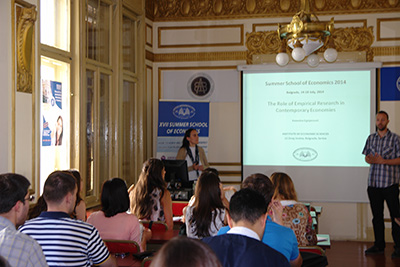
Second lecture of the fourth day was given by Ms. Kosovka Ognjenovic, researcher of the Institute of Economic Sciences. She held presentation titled „The Role of Empirical Research in Contemporary Economies“ presenting the main phases of the process of econometric research and arguing the advantages of econometric results in the policy making process and investment decisions.
In the afternoon, Mr. Dragan Filimonovic held a workshop on typical structure of the empirical economic research. He performed simulation of the quantitative research analysis on the example of Bulgaria’s international trade activities using the gravity equation model.
.
Fifth day of the XVII Summer School of Economics
First lectures of the final day of the XVII Summer School of Economics were held by Mr Vladimir Simovic, Associate professor and IES researcher. During the first lecture, Simovic analyzed with participants different aspects of indiscipline controlling at the financial markets with a special reference to the role of credit bureau in that process. In the second lecture, the focus was on internet start- ups and different phases of the e-business. Participants had an opportunity to hear how the internet company could be established and what challenges they could face in that process.
Next lecture was held by Ms Masa Misic, activist of the NGO Serbia on the Move. On a very practical examples, she has shown what are the basic principles of the e-marketing campaign and what are the possibilities of the internet and social networks in resolving important social issues.
The last lecturer at the XVII Summer School was Mr Ivan Bjelajac, employee and what of the co-owners of the company Devana Technologies, one of the largest internet companies in Serbia. Mr Bjelajac held presentation titled „Startups and Running Lean“. In a very interactive atmosphere, he tried to escape from the typical theoretical concepts of start ups based on business plans rather than business models. After his lecture, participants were divided in several groups and tried to present their own business ideas for e-business.
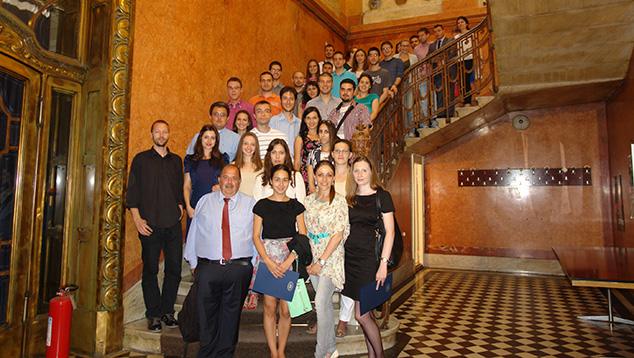
At the end of this year's Summer School of Economics, deputy director, Mr. Ivan Stošić and the Organisation commetee handed out the certificates to students.

- Zmaj Jovina 12, 11000 Belgrade, Serbia
- Phone: + 381 11 2623 055, + 381 11 2622 357
- Fax: + 381 11 2181 471
- Email: office@ien.bg.ac.rs
- Activity Code: 7220
- PIB: 100039204
- Identification number: 07041144


